A Practical Guide to the Trauma-Informed Care Framework

Updated: 7 days ago
Imagine a gardener who doesn't just see a struggling plant but understands its whole story—the soil it started in, the storms it’s weathered, the sunlight it’s missed. That’s the heart of a trauma-informed care framework. It’s not another clinical model to learn; it’s a profound shift in how we see people. It means we stop asking, "What's wrong with you?" and start gently wondering, "What has happened to you?" to restore their voice in their own story.
Shifting Perspectives from Diagnosis to Understanding

A trauma-informed care framework is an approach for human services that assumes an individual is more likely than not to have a history of trauma. It's a way of operating that recognises the widespread impact of trauma and actively works to create environments where people feel physically and psychologically safe, ensuring we don’t accidentally re-traumatise in our attempts to help.
Instead of viewing behaviours as symptoms to be managed, this framework understands them as intelligent adaptations to overwhelming past experiences. It's a fundamental change in lens that allows us to build genuine trust, foster connection, and empower people on their path to healing by honouring their voice.
Why This Approach Is Essential in Australia
This isn't just a compassionate idea; it’s a critical response to a massive public health issue right here in Australia. The numbers are staggering. Research shows that between 57% and 75% of Australian adults will experience a traumatic event in their lifetime.
Digging deeper, recent studies suggest as many as two in three Australians face some form of maltreatment during childhood. You can read the full research on these findings at Emerging Minds.
These statistics make it clear: a trauma-informed approach is no longer optional. It's essential for anyone in a helping profession. It’s about ensuring our services respect a person’s history and actively support their capacity for recovery.
This framework moves beyond simply treating trauma; it involves creating a culture of safety and empowerment that permeates every interaction, policy, and physical space within an organisation. It’s about building a system where a person's voice is not only heard but truly valued.
What It Means for Your Practice
Adopting a trauma-informed care framework means weaving a set of core principles into the very fabric of your daily work. It influences everything, from the way you arrange your waiting room to the language you use on an intake form. The constant focus is on giving clients back their voice and a sense of control.
For clinicians and organisations, this involves a few key commitments:
Building Awareness: Getting skilled at recognising the signs and symptoms of trauma in clients, their families, and even our own staff.
Prioritising Safety: Intentionally creating physical and emotional spaces that feel secure, where people are treated with respect.
Fostering Connection: Emphasising trustworthy and transparent relationships as the foundation for all healing work.
Empowering Choice: Genuinely collaborating with clients and honouring them as the experts in their own lives.
By integrating these elements, you start to build a practice that doesn't just avoid causing more harm. You create a space that actively contributes to a person's recovery, helping them reclaim their story and build a more hopeful future.
The Core Principles of Trauma Informed Practice
A trauma-informed care framework isn’t just a set of ideas; it's a compass that points everything we do towards safety, connection, and healing. These principles are active, observable things that change the entire feeling of a therapeutic relationship or an organisation. They're what turn the question "What happened to you?" into a living practice that gives clients back their power and their voice.
When we weave these principles into every single interaction—from the first phone call to the final session—we build a consistent experience of safety. This consistency is so important because it directly counters the chaos and unpredictability that often define traumatic experiences.
Let's look at what these core principles really mean in the day-to-day work.
Creating Physical and Psychological Safety
Safety is the absolute foundation of healing. Without it, a person’s nervous system stays on high alert, making it almost impossible to do the real work of therapy. This principle goes way beyond just having a secure building; it’s about creating an atmosphere where someone feels genuinely, psychologically safe.
This means a client feels safe enough to be vulnerable, to disagree with you, or to just be themselves without worrying about judgement. For a practitioner, this could be as simple as clearly explaining confidentiality, offering a choice of where to sit, or keeping a calm, predictable tone of voice.
A person's sense of safety is deeply personal. What feels safe to one person might not for another. This is exactly why a trauma-informed approach can never be a one-size-fits-all model. It demands our constant curiosity and a readiness to adapt to what an individual actually needs.
Building Trustworthiness and Transparency
For someone whose trust has been broken, trust isn't just given—it’s earned, often slowly and carefully over time. The principle of Trustworthiness and Transparency is all about being reliable, consistent, and completely clear in our actions.
Think of it like being a dependable guide on a really tough journey. It means doing what you say you’ll do. It means being on time for appointments and being honest about the limits of your role. If you promise to send a resource, you send it. If a session needs to be rescheduled, you communicate that as early and clearly as you can. Every one of these small, consistent actions builds another layer of trust.
Fostering Collaboration and Mutuality
The old way of doing things in many helping professions can feel very top-down. The practitioner is the "expert," and the client is just there to receive care. A trauma-informed framework completely flips that script. Collaboration and Mutuality means we recognise that healing is a partnership.
This principle honours the client as the true expert in their own life. It’s about making decisions with them, not for them.
In Practice: This could look like creating a therapy plan together, regularly checking in on the pace of the work, or asking, "What feels most important for us to focus on today?"
The Outcome: This way of working sends a powerful message that the client's perspective is valued. It helps level out the power dynamic and gives their voice true weight in the therapeutic alliance.
Honouring Empowerment, Voice, and Choice
Trauma often strips people of their sense of agency—their feeling of being in control of their own lives. The principle of Empowerment, Voice, and Choice is about actively working to hand that power back. It’s like giving the map back to the client and trusting them to help navigate.
Every chance we get to offer a choice, no matter how small, can be a powerful act of healing. It could be as simple as asking if they’d prefer to talk about a difficult topic now or later, or even if they’d like a glass of water. It acknowledges their autonomy and reinforces that their voice matters. By consistently offering choices, we help people rebuild their sense of control over their own lives.
This principle also means we have to genuinely believe in each person's inherent strengths and their capacity to heal. Our job isn't to fix them; it's to help them see and build on the strengths they already have.
How to Implement Your Trauma-Informed Framework
Going from understanding the principles to actually applying them in your daily work can feel like a huge jump. But putting a trauma-informed care framework into practice isn’t about a massive, overnight overhaul. It’s about making a series of small, intentional changes that build on one another over time.
This is a practical roadmap for everyone, from solo practitioners to large organisations. It’s about taking realistic steps that start right where you are, using the resources you have, to create a culture where every person feels safe and their voice is valued.
Starting with a Gentle Assessment
Before you can build something new, you need to know your starting point. This first step isn't a critical audit; it's a gentle, curious look at your current practices. Think of it as looking at your work through a trauma-informed lens to see what’s already working well and where small tweaks could make a big difference.
Try asking yourself or your team a few simple questions:
Physical Space: Does our waiting area feel calm and welcoming? Are there options for people who might feel overwhelmed by noise or activity?
Initial Contact: What’s it like for someone calling us for the first time? How do our intake forms read—are they gentle or intrusive?
Language: What words do we use in our policies, on our website, and in our sessions? Do they empower clients or create a power imbalance?
This isn’t about finding fault. It’s about gathering information with compassion to guide your next steps. For a solo practitioner, this might be a quiet afternoon of reflection. For an organisation, it could be a series of collaborative team discussions.
Gaining Team Buy-In and Finding Training
A trauma-informed care framework is most powerful when it’s a shared commitment. For organisations, getting buy-in from everyone—from reception staff to leadership—is the key to creating a truly consistent culture of safety.
This process often starts with foundational training that helps everyone understand the 'why' behind the 'how'. When team members see that this approach can reduce staff burnout and improve client outcomes by giving clients their voice, they’re much more likely to get on board.
True implementation is a collective effort. It’s not just a clinical directive but a shared cultural value that shows up in team meetings, supervision, and how colleagues support one another through difficult days.
Look for training that is practical and relevant to your specific context here in Australia. The goal is to give your team a shared language and a clear understanding of the core principles so they can apply them confidently in their unique roles.
Adapting Your Physical Environment
The physical space where care happens sends powerful messages about safety long before a single word is spoken. Adapting your environment doesn't have to be expensive or complicated; small changes can have a huge impact on a person's nervous system.
For example, a busy clinic waiting room could create a 'quiet corner' with softer lighting and comfortable seating away from the main foot traffic. A solo practitioner might ensure their therapy room has uncluttered surfaces, natural light, and offers the client a choice of where to sit.
Consider these small but meaningful adjustments:
Using clear, easy-to-read signage to reduce confusion and anxiety.
Offering amenities like water or tea to signal care and welcome.
Being mindful of sensory inputs like loud noises, strong scents, or harsh lighting.
These changes communicate deep respect for a client’s experience and help create a space where they can feel safe enough to begin healing. When working with the nervous system, techniques like titration and pendulation are key to gently processing trauma, and a safe environment is the first step. You can explore these concepts further by learning more about moving trauma through the body.
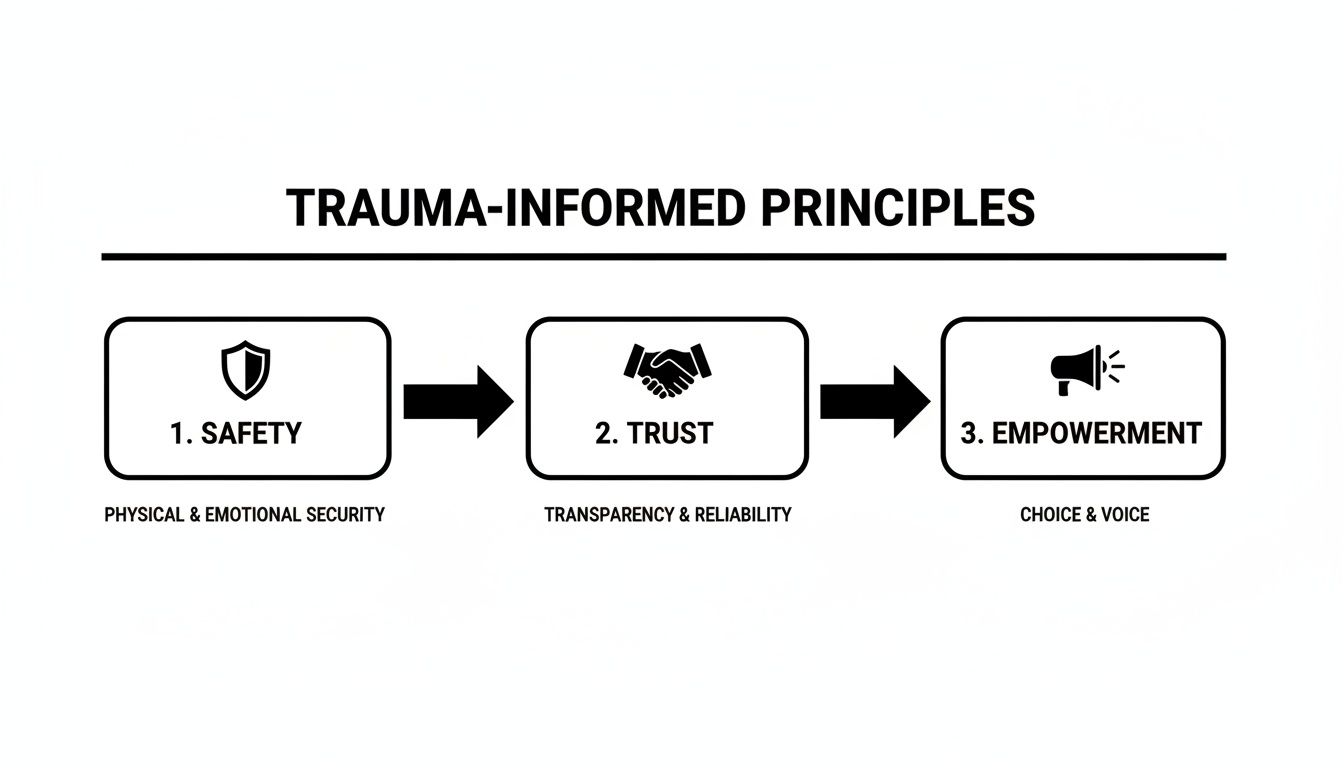
This visual highlights how physical and psychological safety form the essential foundation upon which trust can be built, ultimately empowering clients to reclaim their voice.
Reviewing Policies and Procedures
Finally, take a look at your operational "rules"—the policies and procedures that guide how you work. Do they reflect a real commitment to collaboration and choice? Are they designed for the convenience of the organisation or the wellbeing of the client?
A trauma-informed review might lead to changes like:
Flexible Scheduling: Revising rigid cancellation policies to be more understanding of the challenges clients may face.
Transparent Communication: Creating clear, simple explanations of confidentiality, fees, and what clients can expect from your service.
Client Feedback: Establishing a safe and anonymous way for clients to give feedback about their experience, ensuring their voice guides your improvements.
By weaving these principles into your daily operations, you shift trauma-informed care from an abstract idea to a tangible reality. It becomes the consistent, reliable way you do things, building a resilient framework that genuinely supports healing.
Integrating Cultural Safety and Child Safe Practices
A trauma-informed care framework falls short if it doesn't acknowledge the deep, collective wounds carried by whole communities. For many, trauma isn’t just a single event; it's a systemic and intergenerational experience woven into the fabric of history, culture, and identity. This is especially true for Aboriginal and Torres Strait Islander peoples.
To truly honour a person's story, we have to see beyond their personal history to the broader cultural context that shapes their reality. This means expanding our framework to actively embed cultural safety and child-safe practices, making sure our care is not just well-intentioned but genuinely respectful, inclusive, and healing for every single person who walks through our door.
Weaving Cultural Safety into Your Framework
Cultural safety is so much more than cultural awareness. It’s an active, ongoing process of self-reflection and organisational change that creates an environment where a person feels safe, respected, and supported in their cultural identity. It shifts the focus from the client's culture to the practitioner's own culture and potential biases.
In practice, this means getting real about the power imbalances that exist in healthcare settings and working to correct them. It’s about creating a space where a person doesn’t have to "give up" who they are just to receive care.
Cultural safety is ultimately defined by the person receiving the service. It’s their experience of the interaction that matters most, not our perception of how culturally competent we believe we are. This requires humility and a genuine commitment to listening and learning, truly giving voice to their perspective.
Embedding this into your trauma-informed framework involves concrete actions. It’s about building relationships, not just delivering services. For a deeper dive, you can read our detailed guide on inclusivity and cultural safety in practice.
Practical Steps for Cultural Responsiveness
Integrating cultural safety requires intentional effort and a willingness to adapt how you work. It’s a journey of continuous learning, not a destination you arrive at.
Here are a few practical ways to begin:
Community Partnership: Build genuine relationships with local community leaders, Elders, and cultural organisations. Ask for their guidance on how your services can be more accessible and respectful—and be prepared to listen and act on their advice.
Adapting Your Approach: Be flexible with your service model. This might mean offering sessions in a community setting, incorporating storytelling or art, or understanding that concepts of family and time may differ significantly from a Western clinical model.
Reflecting on Your Practice: Regularly use supervision to examine your own cultural background and how it influences your interactions. This self-awareness is the bedrock of providing truly safe care.
These steps help ensure your trauma informed care framework is responsive to the lived realities of the diverse communities you serve.
Creating Genuinely Child Safe Environments
For children and young people, safety is everything. A trauma-informed approach must be deeply interwoven with robust child-safe practices that go far beyond basic compliance. It’s about creating environments where children feel—and are—seen, heard, respected, and empowered.
This means actively listening to children's voices and taking their concerns seriously. It involves designing physical spaces that feel welcoming to them, using age-appropriate language, and viewing every single policy and procedure through the lens of a child's wellbeing.
For example, an intake process could be redesigned as a gentle conversation with pictures or play, rather than a formal interview. This simple shift can make a world of difference for a child who has experienced trauma, helping to build trust and give them back a sense of control. True safety for children means actively championing their voice in every aspect of their care.
Sustaining Your Practice with Supervision and Feedback
Bringing a trauma-informed care framework into your work isn't a "set and forget" task. It’s a living, breathing commitment that needs ongoing attention to stay authentic and effective. Think of it like a garden: you can't just plant the seeds and walk away. Practitioners need to continually nurture their skills and wellbeing to sustain this deeply human work.
This is where the twin pillars of supervision and feedback come in. They build a supportive structure that keeps you grounded in the principles, helps prevent burnout, and makes sure the framework is actually helping your clients by listening to their voice. Without them, even the best intentions can start to drift.
The Role of Reflective Supervision
Working with trauma means sitting with profound pain, complexity, and uncertainty. It’s demanding work that can take a heavy toll if you're left to process it all on your own. Reflective supervision offers a dedicated, safe space to unpack these challenges.
This isn't about being told what to do or having your performance judged. It’s a collaborative space where you can explore difficult cases, notice your own emotional reactions, and reconnect with the core principles of your trauma-informed care framework. It’s a space to ask, "What was happening for me in that session?" rather than "What did I do wrong?".
Effective supervision is a cornerstone of a trauma-informed system. It models the very principles we aim to offer clients—safety, trust, collaboration, and empowerment—creating a parallel process that strengthens the entire practice from the inside out.
For any practitioner wanting to deepen their skills and maintain resilience, this kind of support is critical. You can learn more about finding the right support through individual supervision sessions designed for exactly this purpose.
Is Your Framework Actually Working?
Creating a trauma-informed environment is one thing; knowing it’s effective is another. How do you measure something as personal as a client feeling safe or empowered? This means moving beyond simple metrics to find meaningful ways to gather feedback, always centring the client's voice.
The goal here is to understand the impact of your approach from the perspective of those it's meant to serve. This is a powerful act of collaboration and humility, reinforcing that the client is the expert in their own experience.
Here are a few practical ways to gather this crucial feedback:
Routine Check-ins: Make it a regular habit to ask clients about their experience. Simple questions like, "How did it feel talking about that today?" or "Was there anything about our session that felt unhelpful?" can offer invaluable insight.
Anonymous Surveys: Offer simple, anonymous feedback forms (physical or digital) where clients can share their thoughts without pressure.
Outcome Measures That Matter: Use tools that capture changes in wellbeing, hope, or a sense of agency, not just symptom reduction. Focus on what clients themselves define as progress.
By actively seeking and responding to feedback, you close the loop. This ensures your trauma-informed care framework remains a responsive, effective, and client-centred practice that honours every person's journey toward healing.
Trauma-Informed Care in the Real World
Knowing the principles of trauma-informed care is one thing. Seeing them change lives is another. This is where the theory gets real, where the rubber meets the road.
The shift from asking, “What’s wrong with you?” to “What happened to you?” isn't just about changing words. It’s a fundamental shift in action that directly impacts a person's safety, their willingness to engage, and their capacity to heal.
Let’s look at two common scenarios in Australian clinical practice, comparing a standard approach with a trauma-informed one. These examples show how a different lens can completely change the outcome and, most importantly, give a client their voice back.
Case Study: Anxious Adolescent
An adolescent, let's call him "Leo," is referred for anxiety. He's withdrawn, won't make eye contact, and only gives one-word answers. A standard approach might jump straight to teaching coping skills like breathing exercises or challenging his negative thoughts.
A trauma-informed clinician, however, sees these behaviours as potential safety strategies. Instead of pushing him to talk, they focus on creating a safe, predictable space first. They might say something like, "We don't have to talk about anything you're not ready for. How about we just start by noticing what feels okay in this room right now?"
This simple shift respects Leo’s need for safety. By slowing right down and handing Leo control over the pace, the clinician builds trust. Eventually, Leo shares that his anxiety is rooted in witnessing intense family conflict—a critical detail a symptom-focused approach could easily miss. The goal then becomes about processing trauma, not just managing anxiety.
Case Study: A Re-Traumatising Intake Process
An organisation supporting people affected by family violence notices a huge number of clients drop out after the first appointment. Their standard process involves a long intake form demanding explicit details of violent events, which clients have to fill out in a busy, public waiting room.
Realising their own process was part of the problem, the organisation decided to rebuild it through a trauma-informed care framework. The goal was simple: give clients back a sense of control from the very first moment they walked in.
They redesigned their intake from the ground up. The long, intrusive form was replaced with a brief, gentle questionnaire that focused only on immediate needs. The full story was gathered later, in a safe therapeutic space, at a pace the client dictated.
This small but profound change drastically improved how many clients stayed. It sent a clear message: "Your safety and comfort matter more than our paperwork."
This is the power of a trauma-informed care framework in action. It moves beyond just delivering a service to creating an experience where healing can actually begin. For anyone just starting this journey, understanding what to expect in a first session can make all the difference.
Common Questions About Trauma-Informed Care
Even when you understand the principles, moving from theory to practice can bring up some very real questions. It’s natural to wonder about the day-to-day details, the potential challenges, and how this approach is different from other ways of working. Getting clear on these points can build the confidence you need to really commit to this way of being with clients.
Here are some straightforward answers to the questions we hear most often, designed to clear up common hurdles and deepen your understanding.
Does This Mean I Can Never Challenge a Client?
This is one of the biggest myths out there. Being trauma-informed doesn't mean you have to tiptoe around difficult conversations or avoid therapeutic challenges altogether. What it does change is how you approach them.
The focus is on making sure a foundation of safety and trust is rock solid first.
Challenging a client is done collaboratively, not confrontationally. It’s a gentle process, and you’re constantly checking in to make sure they still feel in control. The question shifts from, "How do I push them through this?" to something more like, "Is our therapeutic relationship strong enough to hold this conversation safely?"
Is a Trauma-Informed Care Framework a Type of Therapy?
No, a trauma-informed care framework isn't a specific therapy model like Cognitive Behavioural Therapy (CBT) or Eye Movement Desensitisation and Reprocessing (EMDR). It’s better to think of it as a foundational approach—an "overlay" that shapes the entire environment and every single interaction.
It’s the lens through which you view all your other work. It creates the safe, empowering conditions that are essential for specific therapies to actually be effective, making sure the process itself doesn't accidentally cause more harm.
You can practise any therapeutic modality you are trained in while still operating from a trauma-informed perspective. It enhances the work you already do.
How Is This Different from Just Being Person-Centred?
This is a great question because there’s definitely a lot of overlap, especially with the emphasis on empathy and respect. But a trauma-informed framework brings a much more specific focus to the table. It adds an explicit awareness of just how common trauma is and its profound neurobiological impacts on a person’s nervous system and behaviour.
Being person-centred means you value the client's experience and perspective. Being trauma-informed adds another layer: you understand why a client might behave in certain ways (like being hypervigilant, dissociating, or struggling to trust) and you intentionally work to create safety in response to those specific trauma adaptations.
It’s a subtle but crucial distinction. It makes the entire approach more targeted and effective for survivors, ultimately giving them back their voice and agency.
At Yurandalli Counselling & Consulting, we believe that creating spaces of safety, trust, and empowerment is the foundation of all meaningful healing. Whether you are an individual seeking support or an organisation committed to embedding these principles, we are here to walk alongside you. Learn more about our approach at https://www.yurandalli.com.au.


